Site Content
What is reflection? a reflectometer? How is it used to measure plant quality?
What is refraction? a refractometer? How is it used to measure produce quality
What is spectroscopy? a spectrometer? How is it used to measure soil, produce and even human health?
What is BRIX?
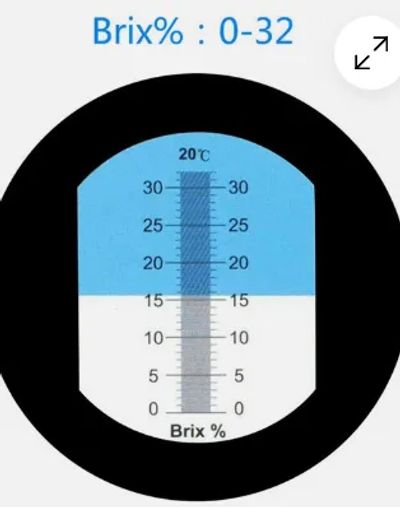
BRIX is a scale of refraction, 0-32 degrees of refraction, developed over 200 years ago by a German scientist, Dr Brix. And has been the best 'objective' measure of produce nutrient density since, according to Health Authorities (NBHMRC) and Food Authorities (FSANZ).
A French scientist developed the Baume' scale for measuring grape nutrient density, so they always pick at the same reading ( say 26 degrees Baume) to maintain a consistent taste or flavour - see here more.
Why BRIX?
If customers can’t find it, it doesn’t exist. Clearly list and describe the services you offer. Also, be sure to showcase a premium service.
Why correlate with BRIX?
BRIX has been the gold standard for 'objectively' measuring produce, food and beverage quality for past 200 years, used by Health Authorities around the world, including our NHMRS and FSANZ.
What Nx does that BRIX does not.
BRIX measures the density of all dissolved solids in produce (fruits, meats, grains and veggies). So, if sugars are increased by whatever means beyond their normal measures, then this increases the BRIX measurement, making it appear more nutritious that it actually is.
Aware of this fact, Nx uses different light ranges and methods to measure sugar content indices (SCI) separately from measuring nutrient density indices (NDIs).
A good example...
In our comparisons, supermarket tomatoes increasingly show sugar-led signals compared with home-grown. That’s why Nx shows two numbers — to separate sweetness from broader density.
A good example...
.. is a new breed of GMO'd tomato being introduced into Australia simply because it is 'sweeter' than others. Customers have questions, you have answers. Display the most frequently asked questions, so everybody benefits.
We want this website to be educational, as well as useful!

What is Refraction?
Summary of Wiki for these purposes :
- Light slows as it travels through a medium other than vacuum (such as air, glass or water).
- When light enters a slower medium at an angle, one side of the wavefront is slowed before the other. This asymmetrical slowing of the light causes it to change the angle of its travel
Once light is within the new medium with constant properties, it travels in a straight line again.
What is a Refractometer?
Summary of Wiki for these purposes :
A refractometer is a laboratory or field device for the measurement of an index of refraction (refractometry). The index of refraction is calculated from the observed refraction angle using Snell's law. For mixtures, the index of refraction then allows the concentration to be determined using mixing rules such as the Gladstone–Dale relation and Lorentz–Lorenz equation.
We want this website to be educational, as well as useful!
About Nutrient Density
The more dense the liquid or sap, the higher the degree of refraction of the light through optical lenses and mirrors as per attached illustration.
Optical Refractometers (BRIX Meters) have been-
- the best 'objective' measure of produce quality for past 200 years!
- used by Aussie farmers for past 80 years!
- used by Food Standards ANZ to provide the right measures for NHMRC's RNI calcs.
- first used (in Trentham, Vic) in 2010 to advise customers on produce quality readings , and produce "Ratings" of poor, average, good or excellent.
Wiki - Nutrient density identifies the amount of beneficial nutrients in a food product in proportion to e.g. energy content, weight or amount of perceived detrimental nutrients. Terms such as nutrient rich and micronutrient dense refer to similar properties.

BRIX, SG and Wort.
Optical Refractometers like BRIX ( = our NutriMeter I or Ni) can be used for a variety of uses besides fresh produce, grains, grasses, etc.:
- SG refers to Specific Gravity measures. mainly liquids. Once approached y by a vintage car enthusiast, very fussy about the SG of the oil his old engine needed.
- Wort is a measure used in the home brewing of beer, very popular in the USA.
Specific gravity (SG) and ingredients
If you have a liquid ingredient, the specific gravity value is used to convert the volume of this liquid ingredient to a gram weight. The NPC does this automatically by multiplying the volume (in mL) by the specific gravity of the liquid ingredient. It needs to do this to calculate a nutrition information panel correctly.
Specific gravity and the nutrition information panel
Paragraph 5(1)(b) of Standard 1.2.8 requires that the average quantity of a beverage or other liquid food in a serving must be expressed in millilitres in your nutrition information panel. A specific gravity value is required to convert the nutrient values present in a 100 g portion of a liquid food to 100 mL, for inclusion on your nutrition information panel.
Below is a range of digital refractometers, less messy, faster and more accurate (to 1 decimal place) than the 200 yr old optical refractometers